follow along at:
https://twitter.com/schutzbank1
Friday, July 26, 2013

Thursday, July 25, 2013
Ruby's 5!


Rhonda led the kids in the popcorn game, the kids loved a mix and match safari card Richie had put together

 Way showed he's a wizard with balloon-making:
Then it was time for a fab cake:

After cake we weren't done - Rhonda and kids had fun on the swing:

and then there was even an impromptu concert and dance performance:

Friday, July 19, 2013
Rwanda and Gorillas
A couple weekends ago, after Rhonda finished up with her work in Rwanda, I was able to meet up with her for a quick vacation. I was pretty excited to visit the country, not only for the gorillas but also to see first hand its recovery from the genocide events of 20 years ago.
The country is very well organized, with clean cities, organized transport, and a general sense of safety. It is pretty amazing to think how far it has come in such a relatively short amount of time.
 Kigali, the capital, has an gorgeous setting among small hills with lots of greenery. To get to the gorillas we took a bus from there to a small town near the national forest where the gorillas are. Despite all the organization we still knew we were not quite in the West when the bus made an unscheduled stop along the side of the road at what we guessed was a well known place to get fresh eggs -- and then someone decided the eggs were not enough they also wanted to bring along the chickens too!
Bright and early the next morning was our gorilla trek. To go on the trek involves a lot of planning since you have to buy permits in advance and they only sell a limited number for each day - thus they are super expensive - over $400 each and that was significantly reduced for us since we are East Africa residents. We chalked it up to a once in a lifetime experience and that the money goes directly to help maintain the environmental conditions for the gorillas.
Before the trek we were treated to a great drum and dance performance:
On the way to the trail head we came across these guys building a house by hand.
 They were still sawing away after our trek!
The countryside was gorgeous - green everywhere, flowers along the road, crops growing in the fields, tall volcanoes close as can be.

and friendly, waving people all over:


On our way back to Kigali, we came across this guy and this crazy home-made bike/scooter thing.

The country is very well organized, with clean cities, organized transport, and a general sense of safety. It is pretty amazing to think how far it has come in such a relatively short amount of time.
 Kigali, the capital, has an gorgeous setting among small hills with lots of greenery. To get to the gorillas we took a bus from there to a small town near the national forest where the gorillas are. Despite all the organization we still knew we were not quite in the West when the bus made an unscheduled stop along the side of the road at what we guessed was a well known place to get fresh eggs -- and then someone decided the eggs were not enough they also wanted to bring along the chickens too!
Bright and early the next morning was our gorilla trek. To go on the trek involves a lot of planning since you have to buy permits in advance and they only sell a limited number for each day - thus they are super expensive - over $400 each and that was significantly reduced for us since we are East Africa residents. We chalked it up to a once in a lifetime experience and that the money goes directly to help maintain the environmental conditions for the gorillas.
Before the trek we were treated to a great drum and dance performance:
On the way to the trail head we came across these guys building a house by hand.

The countryside was gorgeous - green everywhere, flowers along the road, crops growing in the fields, tall volcanoes close as can be.

and friendly, waving people all over:
We had heard from friends that the hike to the gorillas could be pretty intense - straight up steep hillsides, through thick jungle overgrowth, with driving rain. As it turns out, within 10 minutes of exiting our vehicles - there they were - right on the edge of the forest and farmland. It was surreal. But it turned out these were not 'our' gorillas. We were assigned to visit another family/group and the group we had come across were for another group of trekkers - so up the mountain we went. The hike was not so bad though, it was all on an established trail and after about 40 minutes we came to our group - named the Ugenda group.
What an amazing sight and experience to see these wild animals in their environment.

 |
| look at those feet! |

Here's a video of us hanging with them, I got kind of charged at once or twice - the guide said they just wanted to play, but I got out of there darn quick. Stay tuned for the end of the video for a random shot of Rhonda on a motorcycle taxi...
On our way back to Kigali, we came across this guy and this crazy home-made bike/scooter thing.

Sunday, June 30, 2013
English Class in Gihembe – Part II
 The initial 10 days I spent in Gihembe Refugee Camp were long. Our schedule was laid out well in advance with information sessions and assessments for refugees being considered for the ESL Pilot, and training for the two refugee English instructors.
The schedule was already packed without accounting for the countless logistical hurdles that came up. It was unbelievable. For instance, we hadn’t anticipated how involved it would be to sort out which pit latrine we could use so that we wouldn’t have to use the main refugee latrine in the camp, which was, well.. repulsive. I’ve never been so happy to be able to use a pit latrine in my life when we charmed the medical staff into letting us use theirs. We were almost displaced twice – it just went on and on. But, we persevered, and the project start-up proceeded on schedule.
Byumba isn’t exactly a cosmopolitan center. So, the food options were limited. Even eating at the nicest hotel in town leaves my stomach unsettled. Working in the camp means you have to think ahead and have food with you for lunch. Luckily, I had brought some peanut butter and jelly from Kigali, which was good for a couple of days. Still, it gets old, and the wax paper bags just don’t do the job of keeping bread from getting stale (despite the noble environmental efforts that prompted the banning of plastic bags).
So, I was just a little hungry most days – probably nothing compared to the people living in Gihembe. And, no matter how much I tried to keep clean, the camp is unbelievably dusty. There’s no running water for washing hands. Even if people want to be hygienic, there’s no means to do so.
Children were fascinated by us, and it was a joy to reciprocate their greetings, shake their hands, help them with their basic English (they do learn English in primary school – a recent development in Rwanda). Nevertheless, “Mazungu – Mazungu!” got old quickly.
There was one particularly distressful moment when we drove out of the camp at lunchtime, which happened to coincide with when school was getting out. As we drove through the only narrow road that left the camp, a sea of young children in their blue school uniforms were in front of us and around us – so much so that we could barely drive. Of course, as soon as the children realized there were white people in the car, they began the familiar shouting “Mazungu! Mazungu!”, trying to get our attention. But, many also ran as fast as they could to keep up with our car. We were terrified they were going to slip and fall and get run over by one of our wheels. One child even opened the door (lesson learned on locking doors), and it swung open and almost hit people as the car rolled forward.

Another interesting part of camp life was the water spickets.
Only twice a day are they turned on, so people line up with their empty yellow
plastic containers at these critical times. The lines were long, and it was
mostly women and children waiting there and carrying those heavy containers back
home. Children as young as five or six would haul 5 gallon water jugs on their
backs with a long piece of fabric secured around the forehead and underneath
the bottom of the container to keep it secured.
Our classroom was right next to the water spickets just up a
hill, and I found it fascinating to watch the rhythm of everyday life played
out at the spickets. There was a Mama nursing a baby on line. She then passed
the baby into the fabric sling of another woman’s back so she could return to
the task at hand of waiting for water. The woman now with the baby on her back
walked off. I wondered if the woman with
the sling was an Aunt or a friend or what the relationship was. The two women
worked together so seamlessly, it was almost hard to tell which woman was the
mother.
We had invited the “primary applicant” of any case to participate. Sometimes this was a man and sometimes a woman. It was especially enlightening to have an 83 year old woman (the oldest of our group), raise her hand during the Q and A part of our information session. She said, “I have an old man at home (meaning her husband) – shouldn’t he be here rather than me?” I responded, “But you will need to know English, too, once you get to the United States.” Amazed by the prospect that she should matter, she just laughed and laughed as if the idea was preposterous. I guess she accepted it since she had perfect attendance for all 4 weeks of class.

The class got off to a good start. There was such joy in
that classroom. Students knew that this opportunity was rare and that English
would be vital to their success. They so
want a good life – a new beginning. They took class seriously and found an
oasis of mental stimulation, comraderie and enrichment – apart from the
monotony of camp life. My background is not
in education – it’s never been my issue, but I came away with a newfound
appreciation for how transformative education can be.
I was able to return to Nairobi knowing that all was in
place. Of course, I also had a revived
appreciation for the variety of foods I can eat in Nairobi and the pleasure of
a hot shower whenever you want it. Even in Nairobi, we’re spoiled.Just two days ago, I returned to Byumba in time to attend the last day of class. Everyone could say “Good Morning. How are you?” – “My name is Immaculate. Nice to meet you.” Most could tell the 9-1-1 operator what their emergency was and give him an address and phone number in English. We’ll do post-class assessments over the next couple of days to really evaluate the Pilot’s impact, and then we’ll have a graduation to celebrate. Even the 83 year old woman who’s had a much harder time progressing with literacy and numeracy – she’s got a lot to celebrate. Maybe she finally sees that the world hasn’t forgotten her - that we believe in her.
The strangest part of seeing the community in Gihembe is
imagining these same people in New York. It’s a different universe all
together. I just hope people can see her for who she is and all she’s overcome
– beyond her race or her accent. I see now how hard it would be for most people
to have any clue of all that she’s experienced. Maybe that little bit of English will be a
small beginning to bridge the divide.
slummin' it, again!
For a totally different Nairobi slum experience, Way and I took the kids to a music and art festival at the Railway Museum yesterday, the Slum Drummers were going to be playing. I wasn't quite sure if it would be a kid-friendly event, but what the heck I thought, we'll see how it goes.
We were probably the first to arrive at about 4:30p and they were still setting up and the organizer told us the kids would have to leave by 7pm since alcohol would be sold. After a couple minutes milling about it became apparent this whole event was going to be more of a dance / rave festival than anything else. BUT I wanted to see the Slum Drummers do their thang and I DID want to get a taste of the nightlife, even as just an observer who would have leave before the party really got crazy.

Finally after many hours of hanging out, climbing on the old steam trains, and checking out the scene, the music started and the slum drummers were the third act. They didn't disappoint: about a minute into the video they step it up a notch with dancing...
We left Way there and he certainly made the most of it - he made new friends and had a great time - good for him!
 |
| before making it to the festival we checked out the downtown market |

Finally after many hours of hanging out, climbing on the old steam trains, and checking out the scene, the music started and the slum drummers were the third act. They didn't disappoint: about a minute into the video they step it up a notch with dancing...
We left Way there and he certainly made the most of it - he made new friends and had a great time - good for him!
Friday, June 28, 2013
Kibera, a visit to a slum
In my new job I am responsible for a number of administrative functions in my agency, today though I was offered a chance to experience first hand some of the on-the-ground work the agency does. A trip to the field was scheduled to see how a parenting education program is helping improve the lives of Kenyans who live in informal settlements (this is the polite term for slum).
Our destination was Kibera - which so happens to be the largest in the county. It is estimated to house roughly a half a million residents. The alleys are rutted dirt roads with open sewers where sidewalks would normally be. The houses are mud-walled structures with tin-roofs. I knew this all already from reading about it and driving and cycling on the outskirts but I had not yet been inside the actually settlements. It is not recommended to enter unless you are with locals and have an escort. There are also some slum tours but it seemed odd to do that since it feels vaguely exploitative. Going on behalf of my agency was going to be my chance.
 I first thought that maybe the security issues might be overstated but our driver said before we go we would need a security briefing. At the office the agent said we would need an armed escort. I still thought that since we are with the government maybe there was just an abundance of caution. Our first stop was the local "peace officer" where we would meet the partner NGO that would bring us to the program site. Meeting with the peace officer was fascinating, he explained that the locals do not at all trust or respect the police and actually run away when they see them coming. His position is actually a liaison between the police and the residents. He was born and raised in Kibera and after the post-election violence in 2007-8 his department was formed to bridge the gap between the citizens and law enforcement. Certainly it seems it has been successful since there was peace after the March elections this year. Incidentally the peace officer also questioned if we had an escort since our destination was not secure - allrighhtty then, guess we'll take the guards!
 After picking up the armed escort we entered Kibera itself. The roads quickly turned into rutted paths and the density of housing and shops increased exponentially. After bouncing along for about 10 minutes we ventured down a side alleyway into the courtyard of the school where we would learn about the program. We met the facilitators and parents and heard from them how the program has impacted their relationships with their children. What really struck me was how similar their concerns were with middle-class American parents. The curriculum was designed to give them tools to communicate with their adolescent pre-teens by starting to discuss drugs, alcohol, and HIV/sex. I was thinking I hope this is offered in the US when my kids get to be 12! The parents were so thankful for the program and praised how improved their relationships with their kids were now. They also mentioned how academically their children improved as they became more responsible and listened better.
 What was different between this program and what it might look like in suburban America was two things. 1) The percentage of fathers to mothers taking part was huge, out of hundreds of mothers only a tiny % are fathers. In the class I observed there was 18 moms and only one dad. Seems dads are not as present mainly because of the hours they need to work. Typically many are security guards who work 12 hours straight, six days a week. 2) Occasionally they have issues with attendance, examples the facilitators gave were because water was scarce and everyone needed to trek across the settlement to the water trucks and also when food rations were being distributed and they needed to wait in collection lines.
Something else that stood out was the diversity of parents in the programs. There were both Muslims and Christians taking part and they all joined in the prayer that both began and ended the class. The day was a unforgettable experience and the perfect chance to meet Kenyans who make a majority of the population.
Our destination was Kibera - which so happens to be the largest in the county. It is estimated to house roughly a half a million residents. The alleys are rutted dirt roads with open sewers where sidewalks would normally be. The houses are mud-walled structures with tin-roofs. I knew this all already from reading about it and driving and cycling on the outskirts but I had not yet been inside the actually settlements. It is not recommended to enter unless you are with locals and have an escort. There are also some slum tours but it seemed odd to do that since it feels vaguely exploitative. Going on behalf of my agency was going to be my chance.


 |
| page from the parenting education workbook - if you don't communicate, a mud hut you will habitate! |
Sunday, June 23, 2013
Way's here!
Uncle Way arrived a couple weeks ago for a summer of Camp Kenny with Matthew and Ruby. Ruby is still in school, so right now it has been Way and Matthew leading a busy schedule of baseball, chess, self-defense, drumming, writing, art/crafts, etc. Not to mention a couple shopping trips.




In non-Way news, last week before Father's Day Ruby and her school had concert for daddies.


We've also been keeping busy on the weekends checking out some nearby sights. The first weekend he was in Kenya we visited a local park and a market:


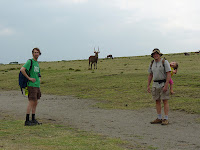
Last weekend we went to Crescent Island where we went on a walking safari with zebras, gazelles, giraffes, wildebeests. En route we stopped for nyama choma (roast meat) and fresh juice.


This past weekend the boys headed over to the arboretum. We had a great time playing ball and getting some Kenyans into the mix too. Later in the afternoon we joined a drum circle and banged away for a couple hours.


In non-Way news, last week before Father's Day Ruby and her school had concert for daddies.

Also Matthew and Ruby's teacher Angie from the Schoolhouse is in Nairobi as an intern for Rhonda's organization. Ruby especially has been having a ball whenever she sees Angie.
Two weeks ago I also started my new job with the Embassy. I am still figuring things out but it has been very interesting and a new experience working in the government sector after many years in corporate life. I thought companies had a lot of acronyms - but in government entire sentences are made up of acronyms - it is like learning a new language!
Also June and July are the 'cold' season here in Nairobi. When not at work, we're still wearing shorts and t-shirts, but many of the Kenyans are buddled up in parkas and wool hats!
Subscribe to:
Posts (Atom)


